
REVIEW: SIRĀT
“Did you die?” These were the first words from Director Oliver Laxe as he sat down for the Q&A at the end of my screening. Sharp exhales and self-soothing laughter emanated from the audience, as if someone told us we were allowed to breathe again. In other words, a resounding yes. Set against the backdrop of a mostly unseen, rapidly expanding global conflict, Sirāt follows a father, Luis, and his son, Esteban, as they search the raves of Southern Morocco for their missing daughter/sister, Mar. There, they meet a group of nomadic ravers, Jade, Tonin, Josh, Steff, and Bigui, who suggest that she might be at another festival happening to the south, “near Mauritania.” Against the group’s advice, Luis follows their convoy of off-road trucks into the desert in an effort to circumvent a military lockdown and reach the festival.
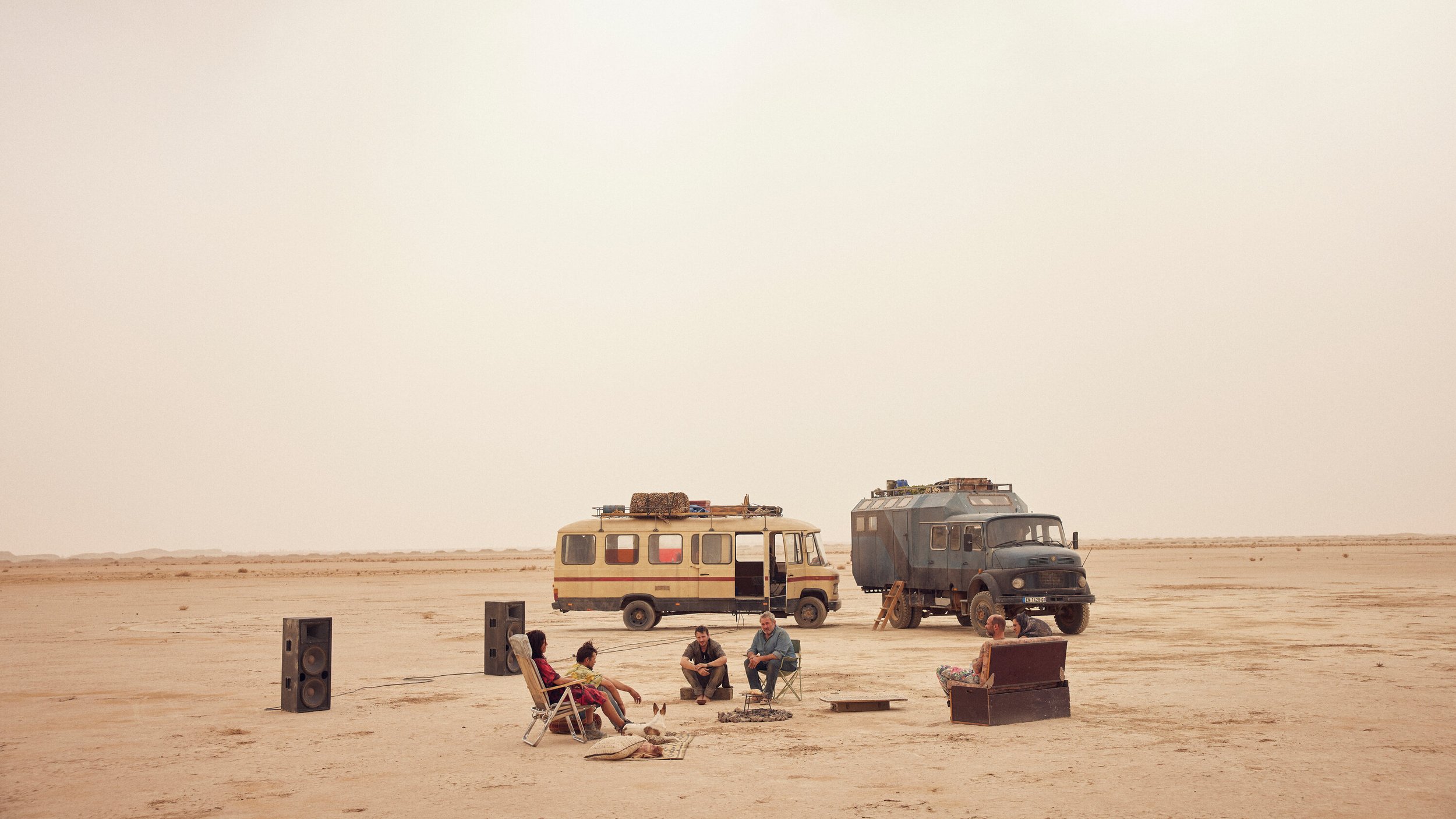
I was at most two minutes into my first viewing of Sirāt when I became aware of the smile growing across my face. The stoic visage of a critical yet objective film buff was gone. I couldn't help it. I was being transported back in time. Back to the dimly lit sweaty basements of Brooklyn and Queens, to the laser lined brutalist facets of Mostra, all the way to the towering speaker stacks of the Miami festival where I fell in love with electronic music 15 years ago. In every face I was reminded of a dance floor fast friend, in every smile a graciously accepted stick of gum or a politely declined cigarette. The opening scenes of this film are perhaps the most sincere portrayal of raves and rave culture ever put to screen. The dancing, expression, and passion ingrained in each frame of Super 16 film are raw, unadulterated, and real. With the exception of Luis, played by Sergi López, and Esteban, played by Bruno Núñez Arjon, none of the other on-screen performers in the film is a professional actor. Instead, they are a collection of creatives, performers, homesteaders, and dancers who were found doing what they love and brought into the desert to rave together. But who they were before and where they came from ultimately does not matter. “Don’t you miss your old family?” Esteban asks Bigui at one point. “Not that much,” he responds, “I prefer this family.” What matters is the here and now. To see these people experience the music they love around their chosen family is entrancing. To then watch them undertake such an arduous and life-altering journey is gut-wrenching.
Falling somewhere between Mad Max, Wages of Fear/Sorcerer, and the Dakar rally, the premise of this journey is simple: three trucks must drive South through the desert. Luis, already a fish out of water in the rave scene but desperate to find his daughter, pushes his ill-equipped small family van deeper into the arid landscape. He struggles to connect with his nonconformist travel companions and grapples with Esteban’s growing fondness for them and their nomadic lifestyle. While clearly afraid to lose his son as he lost his daughter, and as protective as he is, Luis is nonetheless unprepared. “I don't think you understand what you’re getting into” Steff says to him at the beginning of their journey. What comes across as a prophetic warning quickly turns into tragic irony. In a single dramatic moment, the movie turns on its head. Just as you are being elevated to a state of euphoria through sight, sound, and jovial camaraderie, you are released into freefall.
This is the magic of Sirāt. Deep down, you know what’s coming. You know the journey cannot be all smiles and laughter, but you push it to the back of your mind and enjoy the ride. In this way, you and I become like the ravers, and like them we are exposed as the escapists we really are. Whether it’s clubbing in Ridgewood or watching films at the IFC Center, we do anything for a reprieve from the pain in the world around us; I do anything just to stop doomscrolling for a moment. The ravers are the same. They are people desperate to escape the reality unfolding before them. They relish in hedonism and psychoactives, avoid routes that might have military presence, and actively turn off radio broadcasts warning of global conflict, unable to confront the decay and death happening in the world. They drive deeper and deeper into the desert hoping to find an escape, but ultimately they, and we, are met with the inescapable truth that danger, that death, is all around.
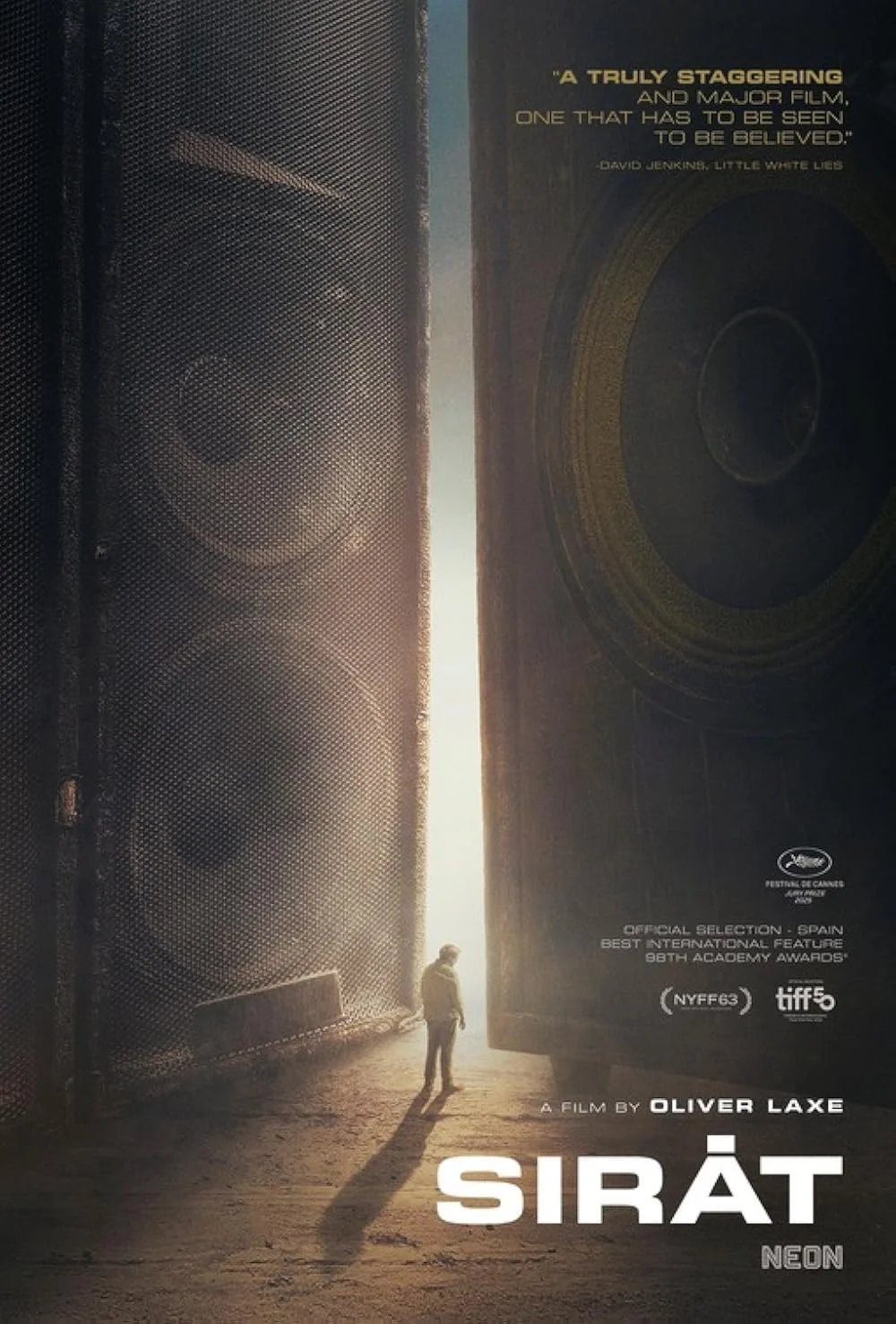
Sound in Sirāt is danger made manifest. As physical harm surrounds the characters, sound envelops you. What Tangerine Dream and Vangelis did for Thief and Blade Runner, David Letellier, better known as Kangding Ray, does for Sirāt. Deep evolving drones and distorted driving drums ripple through the air. Glissandos climb through the octaves and echo into infinity. Ethereal pads swell and recede in long protracted breaths. Layer after layer converges into pleasantly abrasive rhythms that carry the trucks through the desert in beautiful long takes. The vehicles become dancers in their own right, propelled by unstoppable cosmic gears. As the primal forces of the universe spring from the sub bass, the line between diegetic and non-diegetic begins to blur. What is real and what is imagined become inconsequential; In this film it’s what you experience that matters most. And when the soundtrack finally begins to ebb, when the sounds of the world begin to materialize, that experience begins to change. Audiophilic euphoria rapidly devolves into sonic anxiety. It is a comedown like no other. You can cover your eyes and turn your head away to block the images, but sound will always find its way to you. It will worm its way through gaps in your hands and propagate through your jawbone straight to your cochlea. Sound, like reality, is unavoidable in Sirāt. The shrill bark of a dog offscreen, the wind rushing through the desert brush, or the creaking suspension and struggling gearbox of a truck too close to the edge, all will defeat your defenses and make your hair stand on end. The Oscar-nominated team of Amanda Villavieja, Laia Casanovas, and Yasmina Praderas have spun auditory magic. Watching this film on a big screen with proper speakers, experiencing every footstep, every breath, every explosion in all their minute detail is worth the price of admission alone.
“I don’t hear anything,” Luis says to Jade during one of the film's few moments of refuge. Distorted music plays through a speaker cone in disrepair. He strains to make a connection, desperate to understand the world he has lost his daughter in. “It's not for listening,” Jade explains, placing her hand on the vibrating woofer, “it's for dancing.” While masterfully crafted in every aspect, Sirāt isn’t so much heard or seen as it is felt. It is a piercing blow to the chest that forces you to confront a part of yourself you were otherwise unable or unwilling to see. When you stop running from it, when you give yourself over to it, when you allow yourself to die, you will come out the other side reborn.