
Artist of the Moment: Andy Martin
Time is such a thing when it comes to Andy Martin, as it seems he has a capacity to melt ancient and future times together and - like creating a philosopher’s stone - distills out a language of sound that is unique to him and couldn’t be created otherwise, even if the base material would be the same.
His Jamaican-Mexican heritage and philosophical approach naturally reflects in his work (check his dub collaboration with Lee Scratch Perry). The whole matter is carried with such a futuristic edge, that I find him one of the most exciting artists in electronic music today. Andy is running the labels Mole Audio and Diaspora Echoes, and had an exciting run of releases this year. You can find some recently released and a lot of unreleased material in his offworldish and time-defying set at Monument Festival 2026.
His productions are audibly very distinct and so are his DJ sets: They collapse all ages and genres of techno together in a story. But this is just one reason why we talked with Andy. The other one is that he stands for an opening that was very needed: He is one of the few artists that became more popular in Europe while being from Latin America. So while this is about him, it is also about the bigger topic of access, possibilities of development and balance in the electronic music scene beyond Europe.
Hi Andy, thank you for this interview - especially as your touring & release schedule is quite full on these days. You are just returning from an Asia/Australia Tour - what were the highlights?
For me, the highlight was realizing just how many similarities there are between Latin America and Asia. From our fascination with food and the energy of street markets, to the smells in the streets, the syncretism of different religions and beliefs, and the constant coexistence of modernity and tradition, skyscrapers stand alongside centuries old temples. Even the way we seem to naturally navigate the chaos of our cities felt familiar. Despite the geographical distance, I found a sense of familiarity everywhere, and that connection was really fascinating to me. Musically, I think there is something really interesting happening across the whole Asian region, from Australia all the way to India. There is a particular strain of techno emerging that draws quite heavily from psytrance and progressive music, but in a very refined and interesting way.
How does the current increased attention feel? You have been making music for such a long time, yet it was not easy to reach a global audience in that very Western-centric electronic landscape.
I have been making music for the last 18 years, so I feel like there was already some attention around my work on a very small scale in the early years, gradually growing step by step within my local scene. The interest has definitely expanded a lot over the past few years on an international level. I feel very grateful for the attention my music is receiving now, especially coming from somewhere like Latin America, where even today, despite the immediacy of the internet and social media, the music scenes between regions like Latin America, the UK, Europe, and Asia can still feel quite distant from one another and sometimes even unknown.
Mindset and balanced living is something important to you and it is one of the themes that show up in your works. You released a meditation album in 2020 and one of your latest tracks refers to “Toltequidad”, which is somewhat a spiritual pathway related to wisdom of the Toltec culture. Tell us a little bit more about that.
I believe that the idea of an artist living a superstar lifestyle full of excess and emotional torment in order to create meaningful output is a huge cliché. In the long term, that path would eventually break and burn out whoever chooses it. I believe it should be the complete opposite: the more balance you can have in your life, the clearer and better your output can become. For me music is a form of emotional alchemy. Whenever you are sad, you can play your favorite tune and completely change your mood. In a way, you are somehow responsible for the transmutation of other people’s emotions. That can happen through making music, playing music, and many other forms of artistic expression.
In some schools of thought in Mexico, the Toltecs, an ancient civilization that inhabited the region many centuries ago, are considered a wise culture that influenced many of the civilizations that came afterward. Many of their ideas are similar to the Buddhist worldview regarding human suffering, inner work, presence, and consciousness. In conclusion, I believe an artist’s path is a process of self-discovery and emotional alchemy that can resonate with others and help transform those emotions.
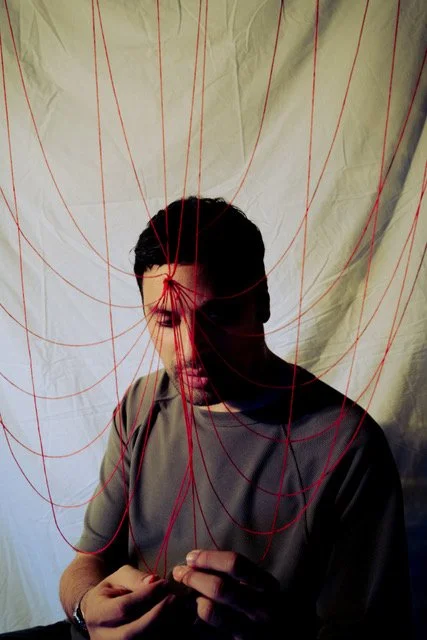
pfoto by vanhoofviktor
Another recurring “sujet” in your music is the future, science fiction and exploring how seasoned, or ancient aspects of culture and music can be carried into the future. What kind of future do you see, hope or wish to create for electronic music in general?
On one hand, I think electronic music has an implicit political impact simply because of its ability to bring people together. It creates spaces where people from a wide spectrum of backgrounds can connect, even though in many other contexts they might never meet or interact in a meaningful way. On a deeper level, I see electronic music as a contemporary form of catharsis. Throughout history, almost every civilization has had rituals where people gathered as a community to share a collective sonic experience through rhythm, music and dance. Electronic music is, in many ways, a modern continuation of that tradition. The technology has changed, but the human need behind it remains the same. I think that, at the moment, music, like many other aspects of our lives, has been largely shaped by our current economic system, often reducing it to a superficial form of currency or content. That can make it difficult for art to fulfill its deeper purpose. My hope is that, in the future, the electronic music scene will be able to overcome some of the limitations that this system creates and reclaim a more meaningful role in society. If electronic music can continue to create spaces where people come together and share transformative experiences, then I think it can have a much deeper and lasting impact than we often give it credit for.
When I listened to your music for the first time, I was intrigued by its connection to ancient Mexican history and myths - like again in your latest Animalia release. How was “Tierra de Nahuales” conceived?
In the mythology of Indigenous peoples in Mexico, there is the concept of the nahual, a person believed to have the ability to transform into an animal. I thought this could be an interesting concept to explore through Animalia, while also creating a direct connection with the label’s name and identity. In my opinion, the rhythms and sounds that make up this EP have a very tribalistic character.
This year is pretty much “on fire" for you with a tight release schedule. You recently brought out Tech039 on Nastia’s Techno label (previously Nechto), the second one within six months. How did that collaboration start?
My relationship with Nastia’s label started in a very organic way. I began sending her some emails with my releases, and after a while, she reached out to ask if I had any demos for the label. So far, we’ve released one digital release and another one on vinyl. It has been a particularly meaningful relationship for me because Nastia was one of the first established artists on that level who showed a genuine interest in my music and what I was doing. From the beginning, her support felt very sincere, and she has continued to be incredibly supportive of my work and my development as an artist. I have a lot of appreciation for her.
I would like to spend a moment talking about Mexico and its artists and scene. How did the local Mexican scene develop over the years in terms of sound?
To explain the music scene in Mexico, it’s important to understand that music was heavily censored in the country for a long time. Mexico used to be an authoritarian country disguised as a democracy. In the late 1960s, there was a massive student massacre carried out by the government, and in the early 1970s there was a huge festival called Avándaro, often considered the Mexican equivalent of Woodstock, attended by hundreds of thousands of people. The government became deeply afraid of the political and ideological ideas associated with the hippie movement and rock music, so rock was heavily censored throughout the 1970s and 1980s. The biggest television company in Mexico, Televisa, was a strong ally of the government, and for decades it had enormous control over the direction of mainstream music in the country, from the 1970s until the early 2000s. Because of this, artists never truly had complete creative freedom and a proper platform. Even though there were already some very interesting electronic artists emerging in Mexico since the 1980s, the constant censorship and lack of support unfortunately prevented many of them from gaining global recognition.
Today, things have changed considerably. Thanks to the internet and social media, the electronic scene in Mexico has grown a lot over the past years. However, there is still not a fully consolidated scene. Instead, there are many micro scenes that emerge, evolve, disappear, and are reborn across different genres and communities. I believe the main challenge today in building a strong long-term scene is economic sustainability. It is much harder to maintain projects, venues, or clubs over long periods of time, most of the promoters that have the financial capabilities of investing in the development of the scene, choose to do it in the mainstream. The issue of violence and drug cartels remains a constant factor that creates uncertainty around any scene development that is achieved.
The influence of european and american partygoers is undeniable in places like Tulum - and not necessarily in a good way. I guess it might be somewhat similar to Colombia - people enter the space to rave, yet local artists barely get booked outside. In the wintertime, however, LATAM tours are a fixed part of the tour schedule of artists from the global North. How has that impacted Mexican cultural spaces and with that, heritage?
In a way, this is also an expression of modern colonialism: creating an entire scene without taking the local community into consideration. In the best-case scenario, organizers might place a couple of local artists in the opening slots of an event, but rarely in positions of real visibility or influence. From the industry’s perspective, these massive festivals obviously need to sell tickets through internationally recognized headliners. But at the same time, the original ethos of electronic music as a community or a tribe has become increasingly empty. In many cases, it has turned more into a commodity driven by financial metrics and branding rather than genuine cultural exchange or artistic connection. There is very little balance.
Speaking specifically about Tulum, it doesn’t feel like it has brought any substantial benefit to the broader electronic music scene in Mexico. It feels more like an isolated bubble run mostly by foreigners, to the point that sometimes it doesn’t even feel like it belongs to Mexico anymore.
Underground organizations like Discos Movimiento and Pervert become more known outside Mexico and there are some partnerships in Europe happening. What would you hope comes out of this “opening”?
Breaking through as an artist in Mexico, and in Latin America in general, is an incredibly difficult task. There are many structural factors working against you: economic instability, inflation, high import costs, and a lack of both public and private platforms supporting the arts. We also don’t have the same infrastructure that exists in other parts of the world, there are very few internationally connected booking agencies, specialized media outlets, or established platforms capable of helping local artists reach audiences beyond the region. What organizations like Discos Movimiento and Pervert are doing is creating, for the first time, a space outside of Mexico where local artists can gain international visibility. They are building a bridge for artists who, under normal circumstances, would probably have found it extremely difficult to access those audiences and opportunities on their own. I hope that in the future more projects like these will take the initiative and help create that visibility for all the artists who have never had the opportunity to be heard outside their own scenes. There is an incredible amount of talent in Mexico and across Latin America.
Who are the Mexican producers and DJs we should keep an eye on?
Concepcion Huerta, Doctor Agujas, Phanta, Octopic, Seli, Niño Arbol, Microhm, Blue Command, Buena Tarde, MNTY, Niño Arbol, Lyo XS, Ursula Prawn, 1o1oo, Süss, MWAMWA, Zoe Malavida, UMAMI, Young Drums, Factory Setup, among many others that I’m probably forgetting to mention.